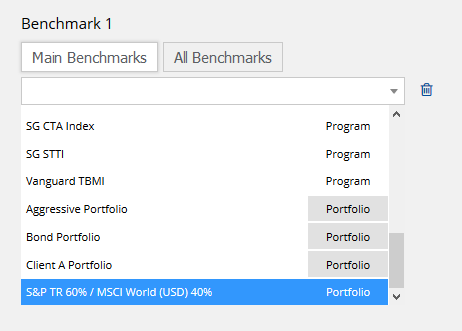
The Portfolio tool lets you create a customized portfolio by combining your funds, stocks, mutual funds, ETFs, indices, managed futures, or other supported instruments from an external data source.
You can set your own allocations, calculate portfolio performance, and use the portfolio in reports or as a blended benchmark.
This article explains how to create a portfolio, choose the right portfolio type, add instruments, set allocations, and understand the available calculation methods.
What can you use the Portfolio tool for?
You can use the Portfolio tool to:
- create a custom portfolio from multiple funds
- combine funds with external instruments such as stocks, ETFs, indices, or managed futures,
- set your own allocation weights,
- create fund-of-funds style portfolios,
- build blended benchmarks,
- compare a strategy against a custom benchmark mix,
- create a historical performance series for a selected allocation,
- prepare portfolio reports based on your selected instruments.
Before you start
The Portfolio tool is available from the Premium package and higher. It is not available in the Basic package.
Before creating a portfolio, make sure you have:
- access to the Portfolio tool in TopSheets,
- at least one program or instrument you want to include,
- the target allocation or investment amount for each portfolio item,
- a clear idea whether you want a hypothetical portfolio or a tracker portfolio.
If you are not sure about the difference between programs and portfolios, see this topic.
Portfolio types
When you create a new portfolio, TopSheets asks you to choose the type of portfolio you want to build.
Hypothetical portfolio
Use a hypothetical portfolio when you want to create a portfolio based on a selected set of instruments and allocation weights.
This is useful when you want to model how a selected mix of funds, programs, indices, or other instruments would have performed historically.
Tracker portfolio
Use a tracker portfolio when you want to manage allocation changes over time.
This is useful when the portfolio composition changes historically, when allocation weights are adjusted, or when instruments are added or removed over time.
If you are creating a simple blended benchmark with fixed weights, a hypothetical portfolio is usually the easiest option.
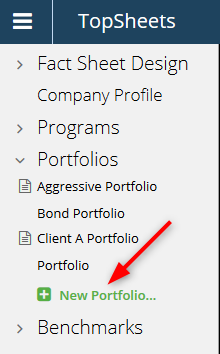
1. Create a new portfolio
To create a portfolio:
- Click New Portfolio in the left sidebar.
- Choose the type of portfolio you want to create.
- Select either Hypothetical Portfolio or Tracker Portfolio.
- Continue to the portfolio setup screen.
2. Add portfolio instruments
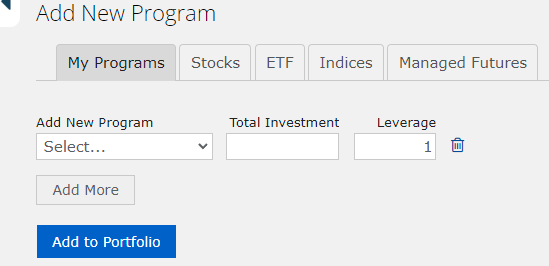
In the Add new program section, add the instruments you want to include in your portfolio.
You can combine your own TopSheets funds with supported external instruments, such as:
- stocks,
- mutual funds,
- ETFs,
- indices,
- managed futures,
- other available instruments from an external source.
To add an instrument:
- Choose the asset class or instrument type.
- Search for the instrument by name or ticker.
- Set the investment amount or allocation.
- Add leverage if available and needed.
- Click Add to Portfolio.
You can repeat these steps to add multiple instruments to the same portfolio.
3. Set allocations
Allocations are based on the investment amounts you enter for each portfolio item.
For example, if you add two instruments with investment amounts of 60 and 40, the resulting allocation will be 60% and 40%.
Use allocations to define how much each fund, program, index, or other instrument contributes to the portfolio.
4. Choose a calculation method
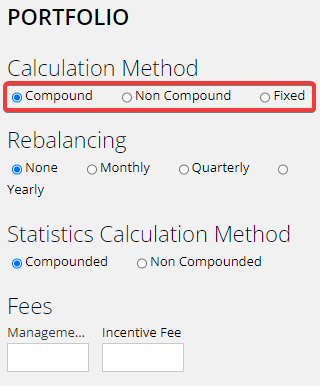
TopSheets supports different portfolio calculation methods.
Compound
The compound method first calculates VAMI values for each program or instrument in the portfolio. It then combines them into a portfolio VAMI and calculates the portfolio’s monthly performance from that combined series.
This means portfolio results are not calculated as simple averages of the individual program results.
Fixed
The fixed method resets allocations to their initial levels every month.
This method is often useful for portfolios or blended benchmarks where the weights should remain fixed over time.
5. Save and review the portfolio
After adding instruments and setting the calculation method, save the portfolio.
You can then review the portfolio results, edit the portfolio later, or use the portfolio in other parts of TopSheets.
To edit an existing portfolio, go to the portfolio edit page. See Edit Portfolio for more details.
Use a portfolio as a blended benchmark
The Portfolio tool can also be used to create blended benchmarks.
For example, you can create a benchmark made of:
- 60% S&P 500,
- 40% MSCI World,
or any other combination of available indices, funds, programs, or instruments.
To create a blended benchmark:
- Create a new portfolio.
- Add the benchmark components as portfolio instruments.
- Set the desired allocation weights.
- Use a fixed calculation method if the weights should remain constant.
- Save and rename the portfolio.
- Assign the portfolio as a benchmark to the relevant program.